From initial call to written report.
Calm, methodical, and paced for our clients managing real health concerns. Here’s exactly what an assessment covers, what gets measured, and how the process unfolds. No surprises, nothing rushed.
What an assessment covers.
Every service is grounded in EPA and NYS Department of Health protocols and Indoor Air Quality Association (IAQA) best practices for assessment and sampling. All lab samples are processed by independent American Industrial Hygiene Association (AIHA) accredited facilities under the Environmental Microbiology Laboratory Accreditation Program (EMLAP).
Mold & moisture inspection
Comprehensive walkthrough with moisture meters, hygrometers, and thermal imaging to identify conducive conditions and visible concerns.
Air & surface testing and sampling
Targeted sampling submitted to AIHA-EMLAP accredited labs for spore identification, speciation, and concentration analysis.
Indoor air quality workup
Broader IAQ evaluation including airborne contaminants, allergens, ventilation, humidity, and environmental triggers.
Written remediation protocol
If remediation is warranted, an itemized written protocol for you and your qualified professional.
Post-clearance verification
Independent on-site verification of contractor workmanship and containment prior to clearance sampling.
Post-clearance assessment & inspection
Final clearance report and sampling letter, suitable for you and your qualified professionals.
Instrumentation
What we measure, and why.
A good assessment isn’t a hunt for mold; it’s a methodical evaluation of the conditions that allow mold to thrive. Four measurements do most of the work.
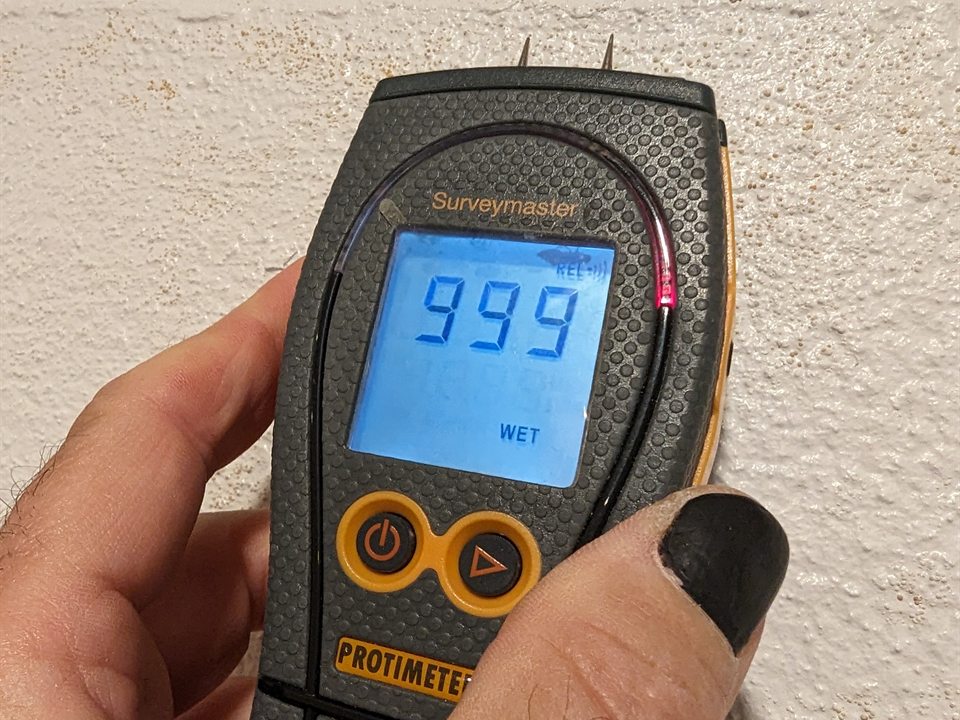
Moisture content of materials
Pin and pinless moisture meters on drywall, framing, flooring, and subfloor. Anything above the manufacturer’s dry baseline gets flagged for follow-up, even when no mold is visible.
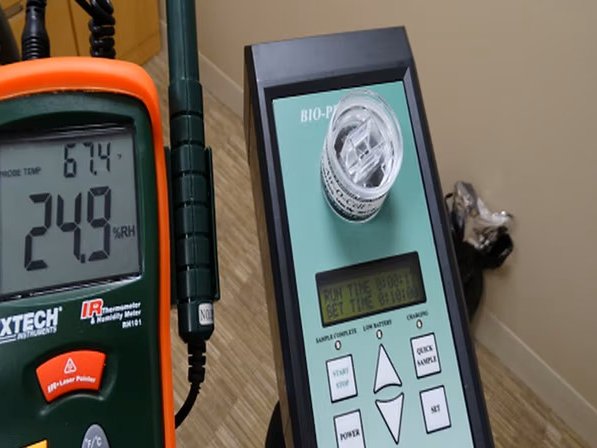
Relative humidity & temperature
Logged at multiple locations over the visit. Sustained RH above 60% predicts mold growth more reliably than any other single measurement, especially in basements, crawl spaces, and behind furniture on cold walls.
Thermal imaging
Identifies cold spots that drive condensation, missing insulation, and active moisture behind finishes, without opening walls. A non-destructive way to direct further investigation.
Air & surface samples
Calibrated spore-trap pumps for the air; tape lifts and swabs for surfaces. Always paired with an outdoor control sample so results are interpreted against the local baseline, not an arbitrary number.
Four steps, start to finish.
Calm, methodical, and paced for our clients managing real health concerns.
Phone consultation
A brief call to review your concerns, symptoms, any known triggers and past or present water events.
Assessment visit
A visual on-site assessment to evaluate and understand the building conditions, explained as I go.
Laboratory analysis
Samples processed at AIHA-EMLAP accredited laboratories. Typically 1 business day for standard panels.
Findings & protocol
A written report with plain-language interpretation, lab results, photos, and a debrief call.
Why the outdoor sample matters.
A spore count taken inside your home means very little on its own. Mold spores are a normal part of outdoor air, and the level outside shifts with the season, the weather and the day. An indoor number only becomes meaningful next to outdoor air sampled at the same time. That is why every assessment includes an outdoor control.
Aspergillus / Penicillium, spores per cubic meter of air
One assessment, three samples taken the same afternoon.
Bar lengths use a logarithmic scale, so each step represents ten times the previous. Illustrative example based on a typical amplification pattern. Every building differs, and your report will carry your own figures.
The living room is normal
Sitting a little above the outdoor level is what an ordinary room looks like. Spores arrive on shoes, on pets and through open doors. A modest indoor number is not a finding, and a report that treats it as one is selling you something.
The basement is a source
91 times the outdoor level cannot be explained by what drifted in from outside. Something in that room is producing spores, and the next question is not what to spray on it, but where the water is coming from.
The count is only half of it. Outdoor air carries a broad mix of genera: basidiospores, ascospores, Cladosporium and others, all in modest numbers. In the basement above, one genus accounted for nearly everything present while the rest all but disappeared. That collapse in diversity is the signature of an indoor source, and it is the part of a lab report a homeowner is least likely to catch on their own.
What to expect, in order.
Here’s exactly how an on-site assessment unfolds. No surprises, nothing rushed. How long it takes depends on the size and age of the building and what we find along the way.
-
Arrival & introductions
We will have a brief discussion to review your concerns, any symptoms you’ve noticed, and the history of the home, including recent leaks, renovations, or weather events worth knowing about.
-
Guided walkthrough
You lead me through the spaces of greatest concern first, whether that’s a bedroom, a finished basement, or a bathroom. I note visual signs, ask questions, and form a mental map of where moisture is most likely to be hiding.
-
Environmental readings
Moisture meters on suspected walls and floors, hygrometer for relative humidity and temperature, and thermal imaging to assist in finding possible hidden wet areas. Nothing evasive or destructive. I explain each reading as I take it.
-
Visual (full-home) building inspection
Accessible areas of the attic, crawl space, basement, mechanical rooms, around windows and under sinks. The places mold actually starts. Photos are taken throughout for the written report.
-
Sampling (if warranted)
Air samples with a calibrated spore-trap pump, surface samples by tape lift or swab where appropriate, and always an outdoor control sample for comparison. If sampling isn’t warranted, and sometimes the cause is obvious, I’ll tell you that and save you the cost.
-
On-site (on-the-spot) debrief
We will review the preliminary findings: what was observed, what concerns are present, and what to expect from the lab if samples were collected. You leave the visit with a clear picture, not just a vague promise of a report later.
-
Written report & follow-up
A plain-language written report arrives by email with lab results, annotated photos, and clear recommendations. A follow-up call is included to review everything and answer questions, on your schedule, not mine.
Held to the standards that matter.
Our inspections, assessments and sampling procedures follow the published guidance and methods that qualified professionals recognize.
NYS Department of Health
Aligned with New York State Department of Health guidance on mold and indoor air quality.
EPA mold remediation guidance
Our process follows the EPA’s published guidelines for assessing and addressing indoor mold.
IAQA best practices
Assessment and sampling follow Indoor Air Quality Association (IAQA) best practices.
IICRC S520 standard
Inspections informed by the IICRC S520 standard for professional mold assessment.
ASTM sampling methods
Air and surface samples collected using ASTM-referenced sampling methods.
AIHA-EMLAP accredited labs
All samples are analyzed by independent laboratories accredited by AIHA under the Environmental Microbiology Laboratory Accreditation Program (EMLAP).